Did You Know? You Can Buy & Sell a Home or Car with a BoE ?
Did you know that when you sell your house using a bill of exchange, you will receive the full asking price? You can also receive an additional 20-40% on top of the asking price! Sounds too good to be true? Trust me, it isn't. This is standard practice for this type of transaction, known as 'different performance'.
The same goes for car dealers and major dealerships: you won't just sell one car, but more likely two or three, or even more, in one go.
Just like the house seller, you will also receive 20–40% over the asking price! It's all 100% legal and lawful!
Yes it is true…
Admittedly, we will sometimes face pushback from the banks because they do not want us to know about this method, let alone use it!
Many people have successfully bought their house with a bill of exchange, also known as a BoE.
Many people also buy cars from new car dealerships and smaller second-hand car showrooms.
The problem with using this method to transact with companies is that 97.99% of businesses either don't know anything about BoE’s or won't change the way they do business because the concept is completely alien to them. The Bills of Exchange Act has been in force in England, Ireland, Scotland and Wales since 1882 — that's 144 years!
The problem is that major banks and governments use BoE’s all the time. It is a common business practice for large companies and government agencies, so smaller businesses are usually completely unaware of it.
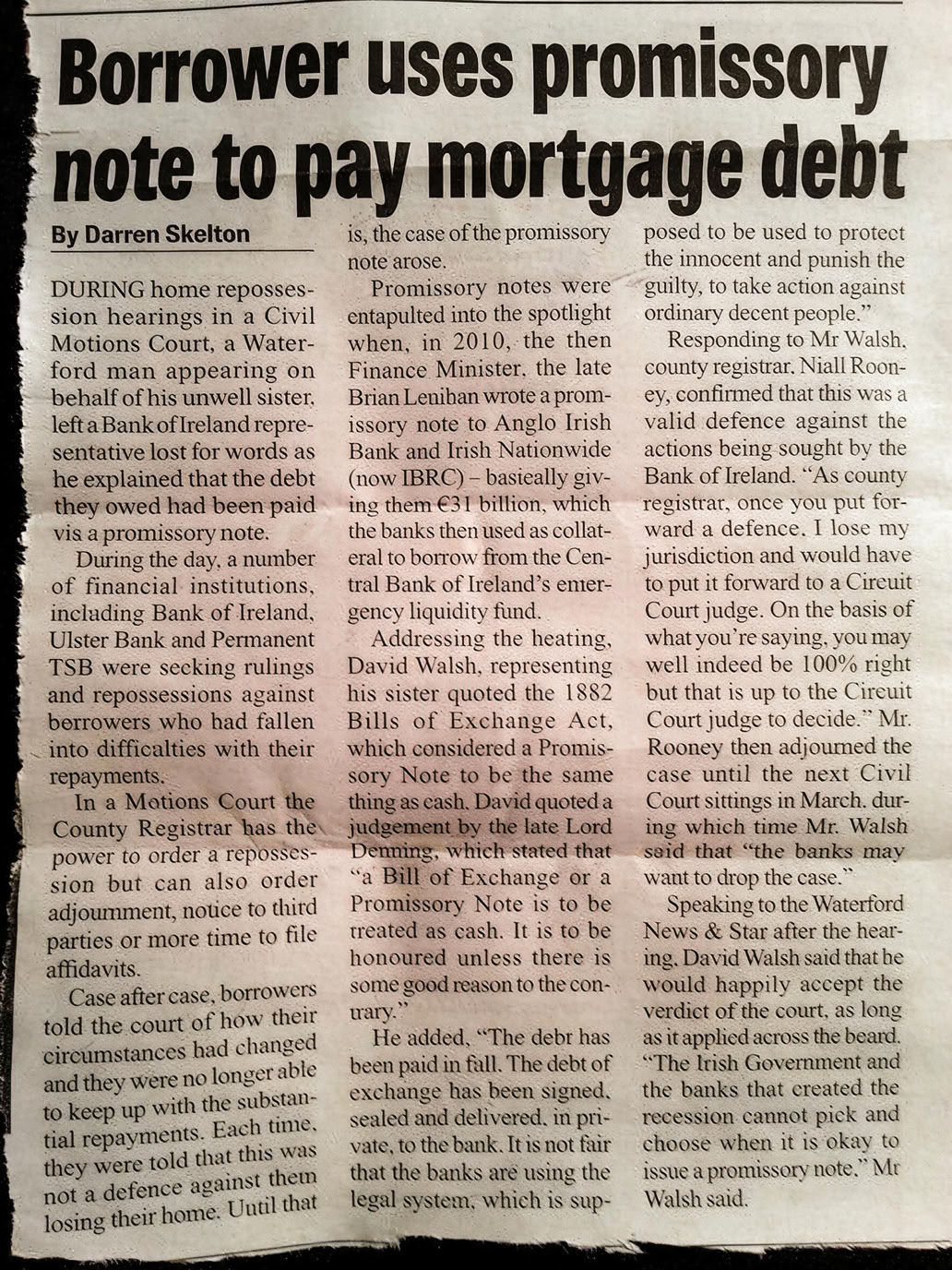
As this newspaper article clearly shows, BoE’s have been used successfully.
Click on the ’News-Paper’ image to download it.
Unfortunately, it is quite difficult to find or track down people and businesses that have bought their house or car with a BoE. This is probably because they just want to keep it quiet for obvious reasons.
If they were to start making YouTube videos about it or speaking on breakfast TV, they would probably become victims of persecution from those at the top. These are the people who do not want this to be advertised.
Understandably, therefore, there is no database of mortgage bankers or car dealerships that are open and willing to accept this 'different performance' way of working.
It is referred to as ‘Different Performance' when using bills of exchange and promissory notes, as mentioned in the newspaper article. (CLICK IT TO OPEN IT).
So…
The purpose of this page is to inform people that this is a genuine system for purchasing large-scale items such as houses and expensive cars.
But, more importantly, they need to understand that those ‘big boys’ in charge at the top will try to put them off with all sorts of tricks and devious business practices.
The problem for them, though, is that it most probably states in their business articles of association that they accept bills of exchange, so they have no option. They can actually get into a lot of trouble for not adhering to their articles of association.
That said, it won't stop them trying to push us away in the hope that we'll go away.
This item has been written in straightforward layman's terms in the hope that whoever is reading it will truly understand what is going on here and be encouraged to be vigilant, knowing that we are right and they are crooked.
If you want to sell your house or a car using a BoE (which is as good as cash), or if you are a car dealership CEO or sales team representative who wants to sell more cars and are willing to join this page and help get BoE's off the ground, then please fill in the form below. We will then connect people who want to buy with people who want to sell. It's that simple!
All information will be kept confidential and no details will be given out directly to anyone without your consent. For example: If John Smith wants to sell his house in East London and Jill Blogs wants to buy a house in the same area (and both are aware of and happy to use a bill of exchange), we will contact each party to ask if they are happy for their details to be passed on.
This is the only way that these types of 'different performance' transactions will ever be successful: both parties must be fully aware of and comfortable with contracting with each other in this way. They will also be fully aware of the possible pushback ahead. Don't forget that there are significant advantages to buying and selling in this way. Usually, the buyer will not only pay the full asking price for the house, but also add a further 20–30% as an incentive for the seller and to cover any additional legal fees. This is unheard of in the housing market.
Everything we do is 100% legal and lawful. It is those who try to push us back who are working outside of commercial law!
So, buyers, sellers and companies, let's get started together today!
WE CAN ONLY WIN IF WE STICK TOGETHER!
CAR DEALERS/TRADERS & HOUSE BUYERS/SELLERS:
This section has two very interesting PDF documents for you to freely download and read. They will change your perspective forever!
Want to know more about Bills of Exchange and how they work?
Click on this PDF below to find out how it works in a simplified format.
This PDF below is a full explanation of how it all works and applies to both buyers and sellers. It is aimed towards buying a car, but the same principle applies exactly to buying a home.
It's quite long, but well worth reading if you want to buy your dream house and/or car. If you are a seller, it will transform the way you trade. You won't have only to hope for a buyer who has the available cash in the bank or a buyer who has a good credit rating.
This is because a Bill of Exchange is considered to be a cash sale.
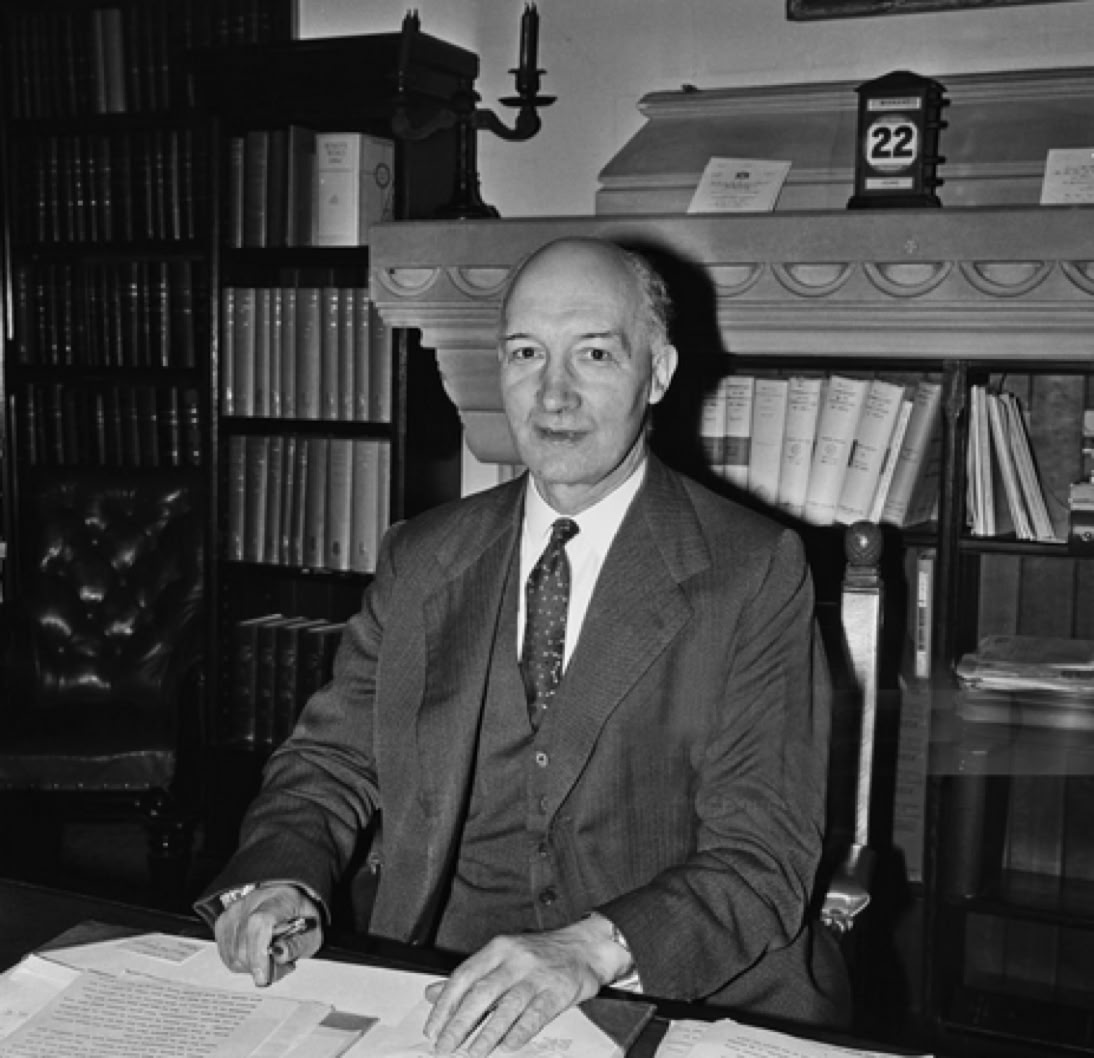
This is Mike Holt, an Australian one-man army who, in my humble opinion, is an absolute genius in the field of bills of exchange and all related matters.
Many people, myself included, have learned a lot from this man. Without him, this website would definitely not exist.
We all have a lot to thank him for, as he is single-handedly teaching the world the truth about the tyranny and corruption that riddle it. Visit his website to learn everything you need to know about bills of exchange and many other topics, as well as his activities, such as taking the Australian government to the ICC.
Mike hosts three weekly video podcasts for Australasia, Europe and the Americas. Join him and his guests to discuss issues that affect us all. Feel free to ask questions and share your experiences as we explore potential solutions together. Our goal is to not only restore our rights and freedoms, but also empower people to defend them with confidence in their knowledge of the law. Mike is not a lawyer, but he has studied the law. He shares his knowledge during the Zoom chats.
TIMES EVERY THURSDAY:
Australasia = 6pm EST Qld :
Europe = 9pm GMT (London) :
Americas = 6pm Central Mountain Time (USA)
No problem at all, that is to be expected for anyone setting out on this journey of discovery in the world of Bill’s of Exchange.
This whole website is totally geared towards helping people with serious questions they might have regarding:
We welcome all your questions.
Your Name:
Your Email:
Ask your question here:
I am interested in:
Select one or more boxes.
Alternatively, please send us a good old fashioned email with your question or inquiry. Click on the email.
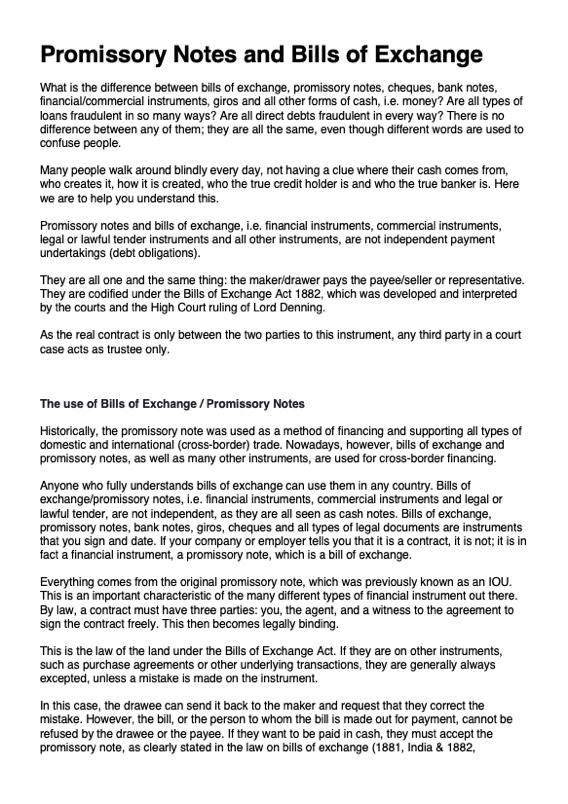
Promissory Notes and Bills of Exchange
Click on document to download
They are all one and the same thing: the maker/drawer pays the payee/seller or representative. They are codified under the Bills of Exchange Act 1882, which was developed and interpreted by the courts and the High Court ruling of Lord Denning.
As the real contract is only between the two parties to this instrument, any third party in a court case acts as trustee only.
The use of Bills of Exchange / Promissory Notes
Historically, the promissory note was used as a method of financing and supporting all types of domestic and international (cross-border) trade. Nowadays, however, bills of exchange and promissory notes, as well as many other instruments, are used for cross-border financing.
With Lord Denning
What is the difference between bills of exchange, promissory notes, cheques, bank notes, financial/commercial instruments, giros and all other forms of cash, i.e. money? Are all types of loans fraudulent in so many ways? Are all direct debts fraudulent in every way? There is no difference between any of them; they are all the same, even though different words are used to confuse people.
Many people walk around blindly every day, not having a clue where their cash comes from, who creates it, how it is created, who the true credit holder is and who the true banker is. Here we are to help you understand this.
Promissory notes and bills of exchange, i.e. financial instruments, commercial instruments, legal or lawful tender instruments and all other instruments, are not independent payment undertakings (debt obligations).
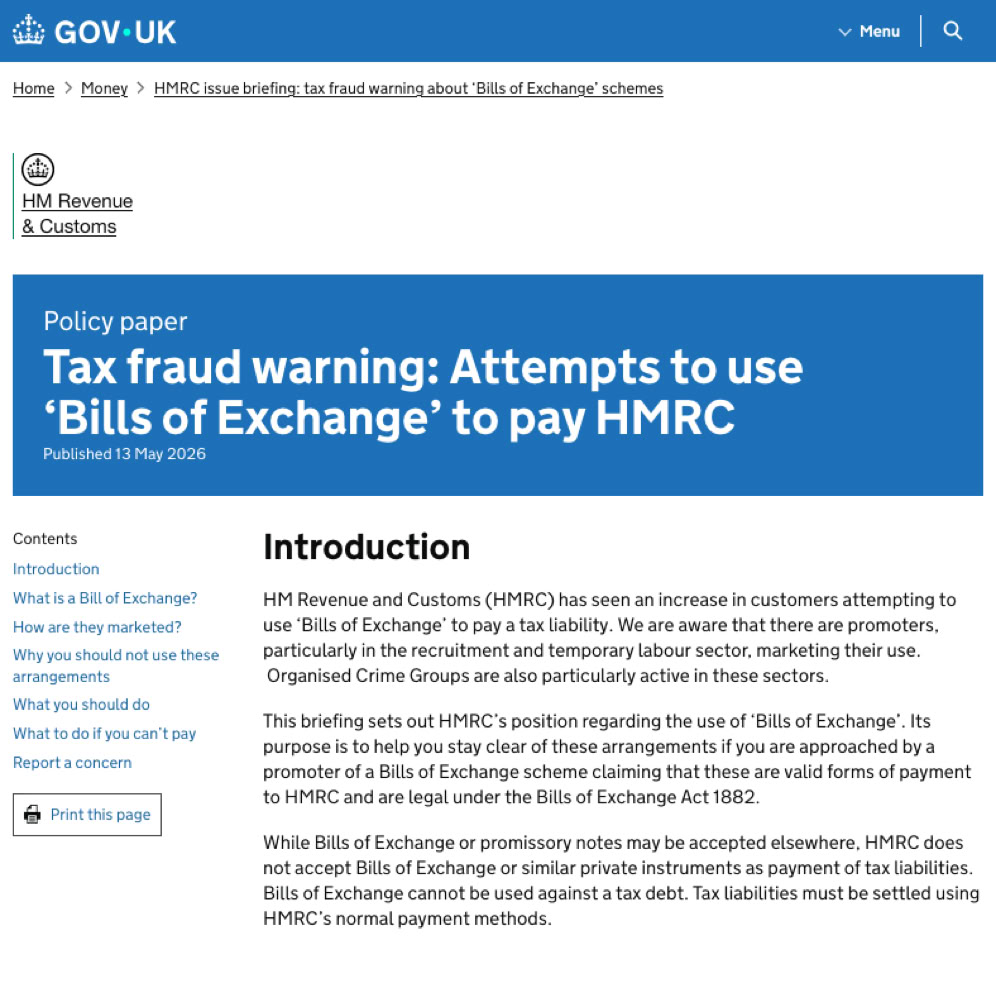
So, What’s the Game HMRC?
1. The HMRC guidance manual (online) contains the following words ‘Where an IOU is involved, you should note the effect of the Bills of Exchange Act
1882/S62 and S89. If the holder of a bill of exchange or of a promissory note either unconditionally renounces their rights in writing, or delivers the instrument to the person liable, this discharges the obligations of the acceptor or promissor, even though no consideration is received. So this is an exception to the rule that a unilateral discharge of a debt requires some form of consideration.’
2. This not only confirms that promissory notes are accepted by HMRC but also that HMRC observes the Bills of Exchange Act 1882 as law.
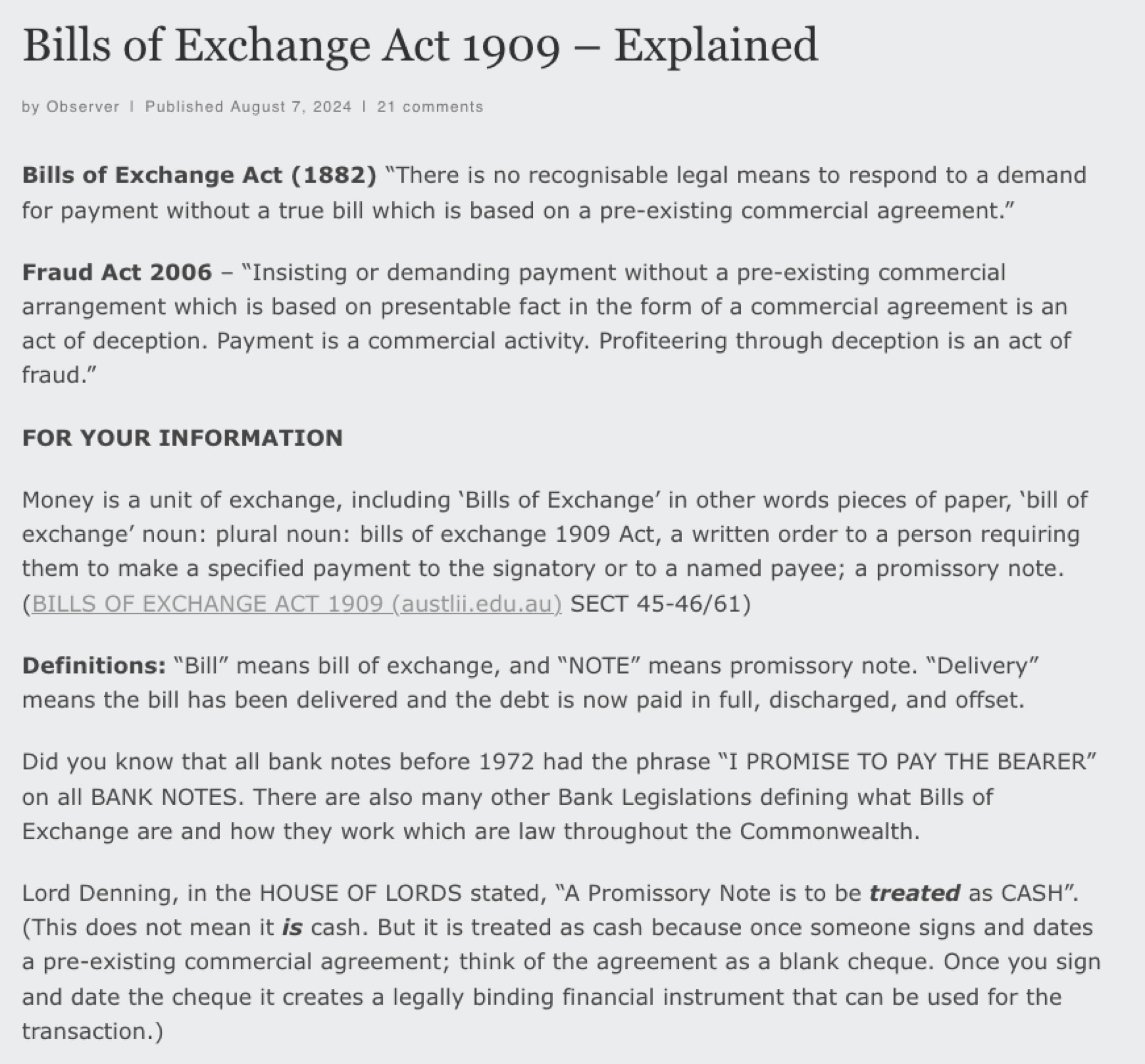
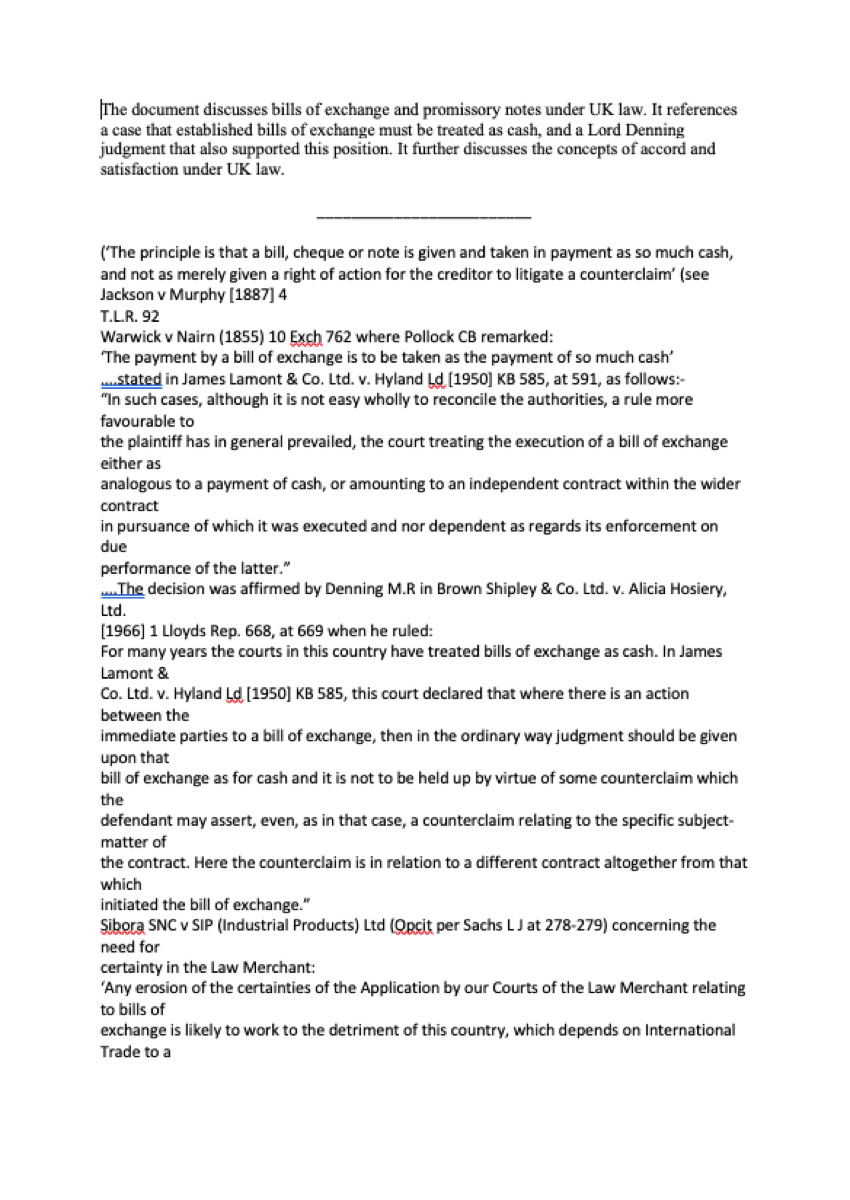
a Lord Denning judgment that says a bill of exchange once tendered has to be treated as cash . . .
HMRC Claim they do not, and will not accept Bill’s of Exchange to settle TAX bills/debts whatsoever!
The IRS in America, essentially, in the same business of stealing money from hard working individuals absolutely and completely accepts Bill’s of Exchange to settle TAX bills/debts.
Lord Denning has made it clear a Bill of Exchange is to be regarded, and treated as cash!
Click on document to download
Aaron Russo talks with IRS Commissioner Sheldon Cohen
Although this is clearly relating to the IRS in America, it is still very relevant to our situation here in Briton with HMRC. All corrupt, all fraudulent and all voluntary.
Neither left- nor right-wing, this startling examination exposes the systematic erosion of civil liberties in America.
Aaron Russo talks with former Chief Counsel and IRS Commissioner Sheldon Cohen. Mr. Cohen also is the AUTHOR of the TAX CODE!
You WILL NOT believe what you hear! The US doesn't want you know know this!
Article XVI which gives the congress the "power" to have a federal income tax, was found to be UNCONSTITUTIONAL by the Supreme Court! How congress can ratify anything found UNCONSTITUTIONAL is BEYOND me!
The Supreme Court declared it unconstitutional in 1895. Referring to the explicit prohibition against direct taxation in Article I, the court argued that the income tax would excessively enhance federal power in relation to state power.
In 1895, in the Supreme Court case of Pollock v Farmer's Loan and Trust (157 U.S. 429), the Court disallowed a federal income tax. The tax was designed to be an indirect tax, which would mean that states need not contribute portions of a whole relative to its census figures. The Court, however, ruled that the income tax was a direct tax and subject to apportionment. This was the last in a series of conflicting court decisions dating back to the Civil War. Between 1895 and 1909, when the amendment was passed by Congress, the Court began to back down on its position, as it became clear not only to accountants but to everyone that the solvency of the nation was in jeopardy. In a series of cases, the definition of "direct tax" was modified, bent, twisted, and coaxed to allow more taxation efforts that approached an income tax.
Congress passed the Sixteenth Amendment to the U.S. Constitution in 1909, and the states ratified it in 1913. The ratification of the amendment overturned an 1895 U.S. Supreme Court decision that had ruled a two percent federal flat tax on incomes over $4,000 unconstitutional (Pollock v. Farmer's Loan & Trust Co., 157 U.S. 429, 15 S. Ct. 673, 39 L. Ed. 759). Article I of the Constitution states that "direct taxes shall be apportioned among the several states ... according to their respective numbers."
What good is the constitution and the Supreme Court if the Senate and House and ratify anything found to be UNCONSTITUTIONAL . It is the Supreme Courts duty to overturn this UNCONSTITUTIONAL ratification.
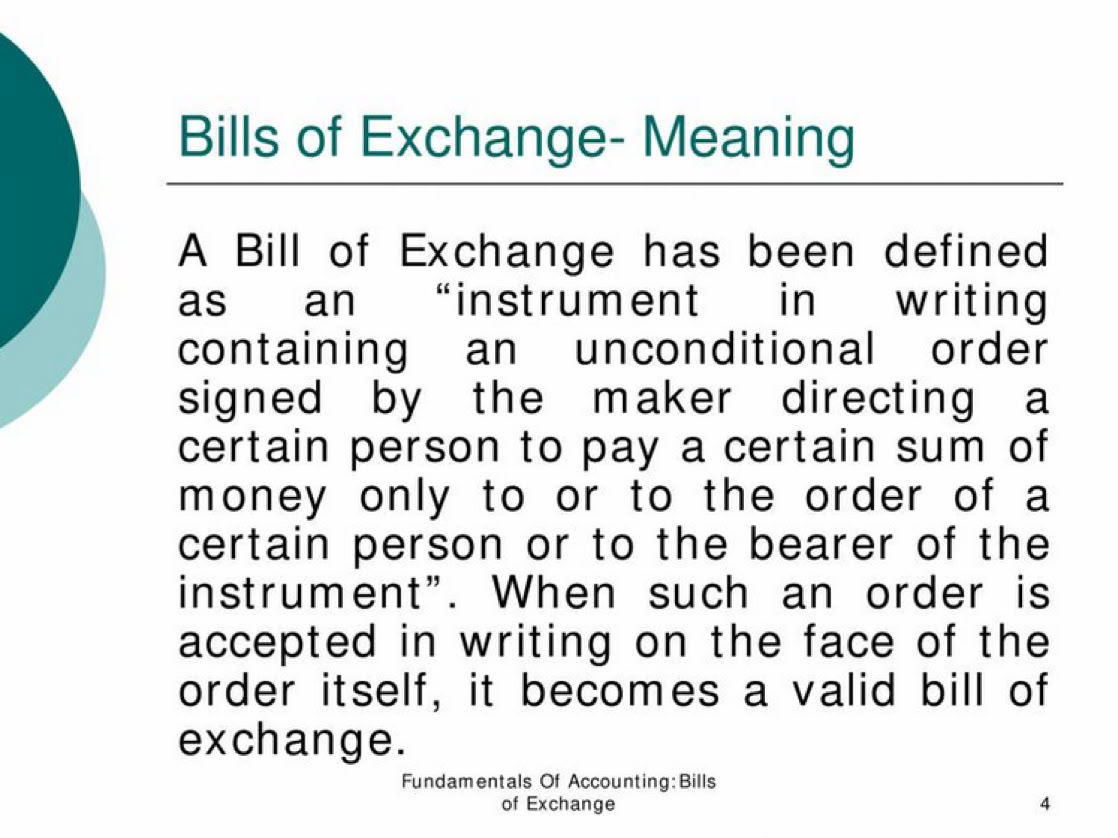
So what are Bill’s of Exchange?
Brief Explanation.
A Bill of Exchange is a lawful financial instrument, recognised under the Bills of Exchange Act 1909 (Australia). It doesn't "buy" the house directly — what it does is discharge a debt obligation.
A mortgage is a debt relationship: the bank has extended credit, and the borrower owes it back. That debt is the entry point for a Bill of Exchange, not the settlement or purchase transaction itself. Once a bill is properly drawn, presented and accepted, Section 48 of the Act provides that the underlying debt is discharged.
The key things that make it valid:
Expect the bank to push back initially and query or reject the instrument — that's normal and doesn't mean the process is wrong, it just means the next step (proper presentment and, if needed, dishonour procedure) has to be followed correctly.
____________________________________
Bills of exchange are an amazing thing, and a seemingly impossible thing all at the same time.
On one hand we ‘ALL’ have the amazing facility to purchase a house or a new car using a simple straight-forward Bill of Exchange comprising of the Bill itself including the supporting documentation, the contract written up between the two parties, (you the buyer and the seller), and that’s it.
It can be a little more convoluted if there are three parties such as. The bank but still a straight forward process.
However, it is very hard going trying to find a car dealership or a house seller, private or commercial, to go through with this form of transaction.
They aren't going to let us get away with not paying if they can help it, as they'd lose out on a lot of money, so don't expect them to be nice when you start to challenge this process. They have in fact already been paid, yet they are still asking you to pay the bill a second time. They are effectively double-dipping into your finances. If you can prove that you are an adult who can handle their own affairs, they will have no choice but to comply with your request.
Firstly, I think it's important to know who you are. You are the creditor and Beneficial Equitable Title Trust Holder. In other words, the funds in the trust that they set up when they created your birth certificate are for your benefit, not theirs. You decide how it's used. If you instruct them to pay your bills from these funds, they are acting as your trustee and must listen to you as the executor/beneficiary of the trust.
Take some time to learn about the Bill of Exchange and how it works. The relevant sections are in the 'Burden of Proof' document in the LIPs BOE files. Look it up. It's a brilliant document to read. Highlight the important parts to help you understand how the bill of exchange works according to the Bill of Exchange Act 1909.
When they send you a bill, it's an offer to pay. If you sign it and send it back, you've essentially sent them a 'bill of exchange', which is no different to a reserve note. They tender it and use it as cash. It's as if you're handing them a 'fiat' currency note. Yes, they can use your BOE as cash. This discharges your debt.
They cannot unreasonably reject payment sent to them via a BOE. The bill with the notes instructing it to be used as money and bearing your signature is called a BOE. A bill of exchange is legal tender.
So, if they've kept the payment, they can't disconnect your power.
Understanding why you are doing this comes first. Then, once you have grasped the concept, you can start putting it into practice and dealing with any objections. Once you have done it a few times, you will understand how it works and be able to do more.
It doesn't matter who you spoke to at Synergy. As long as your BOE was sent to the CEO with a cover letter, the CEO is responsible for anything that happens after that. For example, if they disconnect your power without proper due process, then you have to charge them for it, you can go ahead and charge the man at the top.
If you hold the CEO accountable, they will ensure their staff do the right thing. They all report to him. So, if they do something wrong, they know it's the CEO's head on the chopping block.

Click on a Red file below to save it.
JOIN WITH LIKE-MINDED PEOPLE!
Fill in this form to connect with other like-minded people who want to sell their house using a Bill of Exchange. Also, if you are a car trader, and you want to sell your vehicles and make a good profit, join our club and fill in the form.
Message:
Name:
Email:
Phone:
Choose your interest:
When you click the ‘SUBMIT’ button, it will change colour.
This means it is uploading your files.
Please be patient and wait for the ‘Thank You’ page
© Copyright Bill-of.Exchange 2026